Menu

Chip Encapsulation

06-09-2013
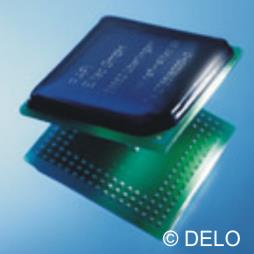
For Chip-On-Board (COB) applications, some form of protection is necessary for the bare silicon Integrated Circuit (IC) and its wire bonds. Typically, COB consists predominantly of surface-mount components, which by their very nature do not require any extra protection against environmental stresses. However, the bare silicon, and the wire bonds that connect the IC to the tracks on the PCB, are fragile by nature, and some form of protection is required. This is provided in the form of a hard black epoxy. For small ICs, a single process is sufficient to ensure this protection. The epoxy is dispensed onto the surface of the IC and flows in a controlled manner to form a dome over the IC and the wire bonds. Heat is then applied to cure the adhesive, forming a hard protective surface over the IC. However, larger ICs require a two-stage process: A high-viscosity epoxy is dispensed to form a wall, or Dam, around the area to be protected, and a chemically-compatible, lower-viscosity epoxy is then dispensed into the cavity to complete the protective covering. This process is known as Dam & Fill, and ideally the Dam and the Fill are cured simultaneously. To view the full article, please click on the link below.

Visit the Inseto (UK) Ltd website for more information on Chip Encapsulation

ENQUIRY FORM

More News

  • Inseto Publishes New Case Study on MEMS Sensor and Microelectronics R&D

  • Inseto Welcomes Adam Wood to Our Technical Sales Team

  • Inseto Welcomes Gary Smith as Technical Support Engineer

  • Inseto at SEMICON Europa 2025: Innovation on Display